
City of Charlotte Small Business Ecosystem Assessment and Strategic Framework
Background
The City of Charlotte’s Economic Development Department acts as the primary agency responsible for promoting economic growth, aiding businesses, and enhancing the city’s overall economic competitiveness. As one of the fastest-growing large cities in the United States, Charlotte’s leadership recognized that small businesses are key to job creation, innovation, and neighborhood vitality, and aimed to better understand how its ecosystem could more effectively support entrepreneurs at all stages of growth.

The Challenge
The City of Charlotte engaged TPMA to conduct a comprehensive assessment of its small-business ecosystem and to develop a clear, actionable strategy to strengthen support systems, improve coordination, and drive more equitable outcomes.
Key challenges included:
-
- A fragmented ecosystem with many resources but limited coordination and navigation support
- Gaps in access to capital, particularly for small and underrepresented businesses
- Limited affordable commercial space, constraining business growth
- Persistent inequities in business ownership and access to resources
- Weak alignment between workforce systems and small business needs
- Barriers to procurement opportunities with anchor institutions
TPMA was uniquely qualified to support this effort because of its national experience in evaluating and designing economic development and entrepreneurial ecosystems, combined with a data-driven, stakeholder-centered approach tailored to complex, multi-partner environments.
Our Approach
TPMA designed and executed a comprehensive, mixed-method ecosystem assessment and strategic planning process.
Stakeholder Engagement and Convening
We engaged a broad cross-section of stakeholders, including:
- Small business owners (over 850 survey respondents; over 55 focus group participants)
- Business support organizations (20+ organizations)
- Economic development, workforce, education, and community partners
- City staff, elected officials, and advisory committees

Analytical and Strategic Tools
We utilized a range of tools and frameworks, including:
- A full ecosystem mapping and gap analysis
- Benchmarking against peer metros (Austin, Nashville, Columbus, Atlanta)
- A small business segmentation framework (microenterprise, Main Street, scalable, mature firms)
- A quantitative and qualitative data synthesis integrating survey data, interviews, and market analysis
- Development of a six-goal strategic framework with implementation roadmap, KPIs, and timelines
System Design and Coordination
We worked closely with the City and partners to design:
- A Business Navigator model to streamline access to services
- A No Wrong Door ecosystem approach
- A multi-stakeholder CRM framework for coordination and performance tracking
- A Charlotte Business Resources (CBR) Partner Roundtable structure to formalize collaboration

Key Themes and Findings
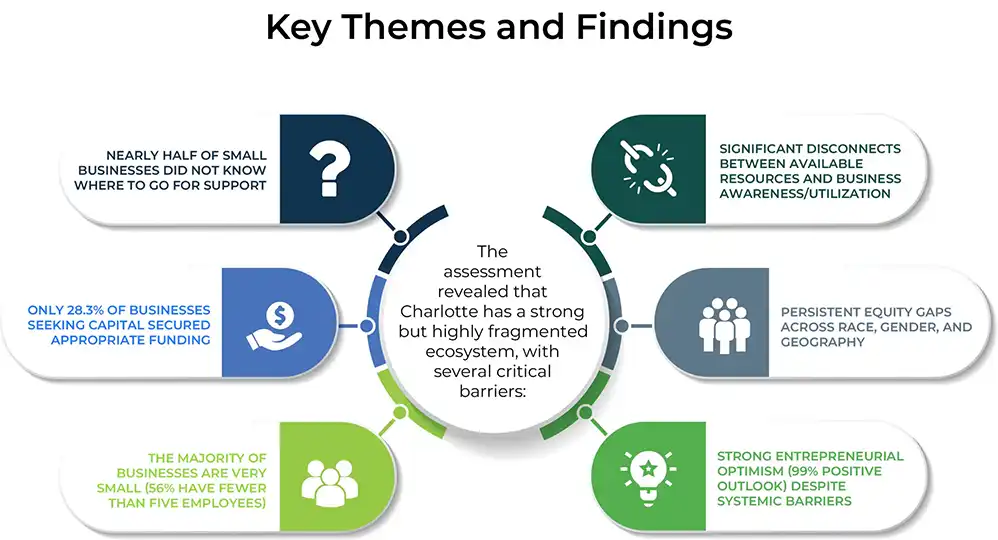
The assessment revealed that Charlotte has a strong but highly fragmented ecosystem, with several critical barriers:
- Nearly half of small businesses did not know where to go for support
- Only 28.3% of businesses seeking capital secured appropriate funding
- The majority of businesses are very small (56% have fewer than five employees)
- Significant disconnects between available resources and business awareness/utilization
- Persistent equity gaps across race, gender, and geography
- Strong entrepreneurial optimism (99% positive outlook) despite systemic barriers
Notable Insights
One of the most important findings was that the challenge was not a lack of resources, but a lack of coordination, navigation, and accessibility.
Additionally, while Charlotte’s ecosystem is robust, it functions more as a collection of programs than a unified system, limiting its overall effectiveness.
Key Recommendations
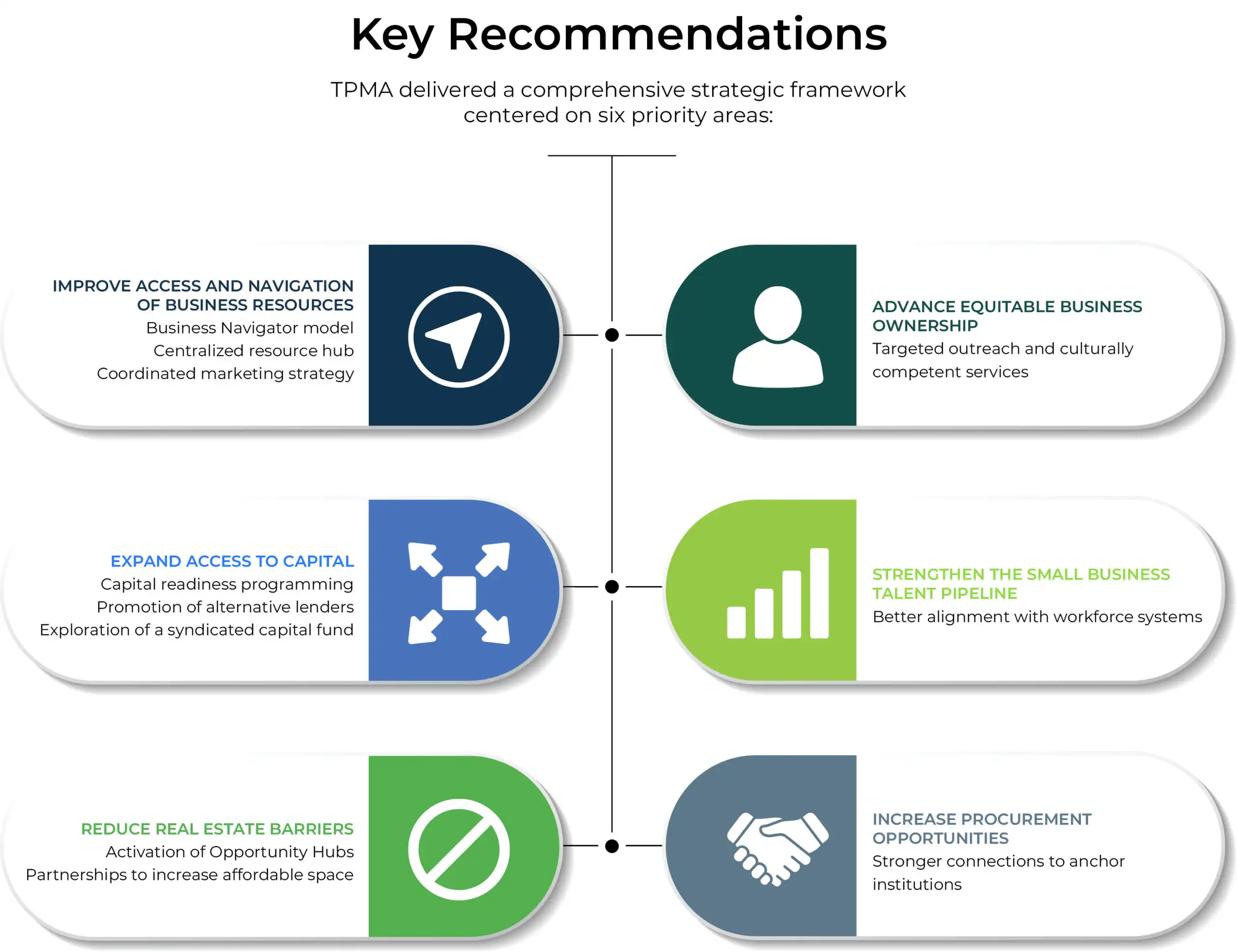
TPMA delivered a comprehensive strategic framework centered on six priority areas:
1. Improve access and navigation of business resources
- Business Navigator model
- Centralized resource hub
- Coordinated marketing strategy
2. Expand access to capital
- Capital readiness programming
- Promotion of alternative lenders
- Exploration of a syndicated capital fund
3. Reduce real estate barriers
- Activation of Opportunity Hubs
- Partnerships to increase affordable space
4. Advance equitable business ownership
- Targeted outreach and culturally competent services
5. Strengthen the small business talent pipeline
- Better alignment with workforce systems
6. Increase procurement opportunities
- Stronger connections to anchor institutions
What We Learned
Through the Small Business Ecosystem Assessment and Strategic Framework, we learned that even well-resourced ecosystems can underperform without intential coordination and system design. Ease of navigation and a sense of trust are just as important as having funding and programs available. Additionally, equity must be designed into systems, not addressed as an add-on.

“One of our key takeaways from this engagement is that for a business ecosystem to succeed, it needs shared accountability, data tracking, and aligned incentives.”
– Brett Wiler, Vice President of Economic Development and Strategic Planning
Client Value and Impact
Through this engagement, the City of Charlotte gained:
- A clear, actionable roadmap for strengthening its small business ecosystem
- A data-driven understanding of gaps and opportunities
- A framework to align dozens of partners under a shared vision
- Tools to track performance and measure impact over time
Community Impact
This work positions Charlotte to:
- Create a more accessible and navigable ecosystem for entrepreneurs
- Increase business formation, growth, and survival rates
- Expand equitable access to capital and opportunity
- Strengthen local economic resilience and inclusive growth